



Paediatric Seating Assessment in Singapore: What Parents Should Expect
By Sabrina Lee
A paediatric seating assessment is a clinical and functional review of how a child sits, moves, rests, learns, travels and participates in daily life. In Singapore, it can help families understand whether a child may need seating support, mobility equipment, positioning accessories or follow-up adjustments.
Quick answer: A paediatric seating assessment helps therapists, caregivers and equipment specialists understand a child’s posture, comfort, movement, pressure care, daily routines and participation needs. The goal is not to make a child sit perfectly. The goal is to support safer, more comfortable daily function.
A seating assessment is not a test your child needs to pass.
It is not about judging how your child sits. It is not about forcing your child into a “perfect” position.
A good assessment should feel like a supportive conversation and observation process. The aim is to understand what kind of support may help your child feel safer, more comfortable and more able to take part in everyday life.
For many parents, the word “assessment” can sound worrying.
You may wonder if your child is being measured for a wheelchair.
You may worry that something is wrong with the way your child sits.
You may feel unsure whether special equipment will be recommended.
These feelings are understandable.
But the assessment is not about placing a label on your child. It is about understanding your child’s body, routine, comfort, safety and participation needs with care.
What is a paediatric seating assessment?
A paediatric seating assessment is used to understand a child’s seating, positioning and mobility needs.
The assessment may look at posture, comfort, pressure care, balance, head control, hand use, movement, transfers, caregiver handling, transport, school routines and home use.
It may also consider how your child eats, communicates, plays, rests and joins daily activities.
In simple terms, the assessment is about your child’s day, not just your child’s measurements.
This matters because seating affects much more than appearance.
A child who is well supported may find it easier to look forward, use their hands, engage with others, eat more comfortably, stay alert in school or travel with less fatigue.
The goal is not simply to make a child sit straighter.
The goal is to support the body in a way that helps daily life feel more manageable, comfortable and meaningful.
Why assessment should come before equipment
It is common for families to start by searching online for wheelchairs, cushions, supportive strollers, headrests or seating accessories.
This often comes from a place of care. Parents want to help quickly.
But paediatric seating is highly individual.
Two children with the same diagnosis may need very different support. One child may need a stroller-style mobility base. Another child may need a wheelchair with specific postural supports.
Another child may need an indoor activity chair, standing support, foot positioning, a specialised cushion, or only minor adjustments to their current setup.
The right recommendation depends on the child’s body, comfort, growth, movement, daily routine and family goals.
That is why responsible seating should be assessment-led, not product-led.
A child should not be made to fit the equipment. The equipment should be selected and adjusted to support the child.
In Singapore, specialist seating services are also available through clinics such as the Seating and Posture Clinic at Cerebral Palsy Alliance Singapore (CPAS). The clinic is run by its Occupational Therapy Department and accepts referrals from allied health professionals, doctors, teachers, training officers and early interventionists.
What the team may look at
During an assessment, the team may observe how your child sits, moves and responds to support.
The team may look at the position of your child’s pelvis, trunk, head, legs and feet. They may also check sitting balance, flexibility, muscle tone, pressure areas, current equipment and how your child’s posture changes over time.
Parents and caregivers may be asked about practical daily routines.
Area of review
What the team may ask or observe
Sitting posture
Does your child slide, lean, arch, slump or become tired while sitting?
Head and trunk control
Can your child hold their head and body in a safe, comfortable position?
Pelvis and hips
Does your child need support to maintain a stable seated base?
Feet and legs
Are your child’s feet supported, and do the legs rest comfortably?
Pressure care
Are there areas of redness, discomfort or pressure after sitting?
Transfers
How do caregivers move your child in and out of the seat safely?
Home and school use
Where will the seating or mobility equipment be used most often?
Transport
Will the equipment need to fit into a car, school bus or other transport routine?
Caregiver handling
Is daily positioning physically difficult or unsafe for caregivers?
Participation
Does seating support help your child eat, learn, communicate, play or rest?
These questions are not meant to criticise what parents are doing.
They help the team understand real life.
A child may sit differently at home than in a clinic. A setup that looks fine for five minutes may become uncomfortable after 30 minutes.
A chair that works in therapy may not fit the family’s car, doorway or daily routine.
Parents bring essential knowledge into the assessment because parents know what happens throughout the day.
Why posture is linked to participation
Posture can sound technical, but posture becomes easier to understand when it is connected to daily activities.
For example, foot support may affect pelvic position. Pelvic position may affect trunk support. Trunk support may affect head control.
Head control may affect vision, eating, communication and hand use.
That is why seating teams often look at the whole body, rather than only the area that seems most obvious.
A child who is sliding forward may be using extra energy just to stay upright. A child who leans to one side may find it harder to use both hands.
A child whose head is poorly supported may become tired more quickly or struggle to look towards people and activities.
Comfort is not a small detail.
Comfort is functional.
When a child is more comfortable and better supported, the child may have more energy for learning, eating, communicating, playing and being with others.
What parents may be asked
A seating assessment often includes many questions.
This should feel like a conversation, not an interrogation.
You may be asked:
Daily difficulty: What feels difficult during the day?
Comfort signs: When does your child seem tired, restless or uncomfortable?
Posture changes: Does your child slide, lean, arch or slump?
Daily activities: How does your child eat, play, communicate or rest?
Use location: Where will the equipment be used?
Transfers: How do caregivers transfer or position your child?
Past experience: What has worked before?
Current challenges: What has not worked?
Family goals: What are your therapy, school or family goals?
It is okay if you do not know all the answers.
You can share what you observe, what worries you and what you hope will become easier.
Small details can be very useful.
For example:
Your child may tolerate sitting better in the morning but become tired by the afternoon.
Your child may sit well during play but struggle during meals.
Your child may be comfortable at home but not during transport.
These details help the team recommend support that fits your child’s actual routine.
What to bring to a seating assessment
Parents do not need to arrive with technical terms.
However, a few practical details can help the team understand your child’s day more clearly.
What to bring or prepare
Why it may help
Current equipment
Helps the team review what your child is already using
Photos or videos
Shows how your child sits, transfers or travels at home, school or therapy
Daily routine notes
Helps the team understand when your child is comfortable or uncomfortable
Transport details
Helps the team consider car, bus, school or appointment routines
School or therapy goals
Helps connect seating support to participation and learning
Caregiver concerns
Helps identify difficult, unsafe or tiring care tasks
Medical or therapy updates
Helps the team consider recent changes in tone, fatigue, growth or health
You do not need everything to be perfectly organised.
Even simple observations can help.
The most useful information is often what parents already know from daily life: what is hard, what helps, what your child enjoys and what you hope will become easier.
What recommendations may include
An assessment does not always lead to complex equipment.
Some children may need simple changes. Other children may need more specialised support.
Recommendations may include:
Seating adjustments: Changes to the current chair, stroller or wheelchair setup
Cushions: Support for comfort, pressure care or pelvic position
Back supports: Additional trunk support for sitting alignment and stability
Head supports: Support for head control, rest or visual engagement
Lateral supports: Side supports to help reduce leaning or improve comfort
Pelvic supports: Positioning supports to help the child sit more securely
Foot supports: Support for feet, legs and seated stability
Trays: Support for play, learning, communication or upper limb activity
Tilt or recline: Positioning features for comfort, rest, pressure care or fatigue management
Mobility bases: Stroller-style bases, manual wheelchairs or powered mobility options
Standing support: Standing equipment when clinically appropriate
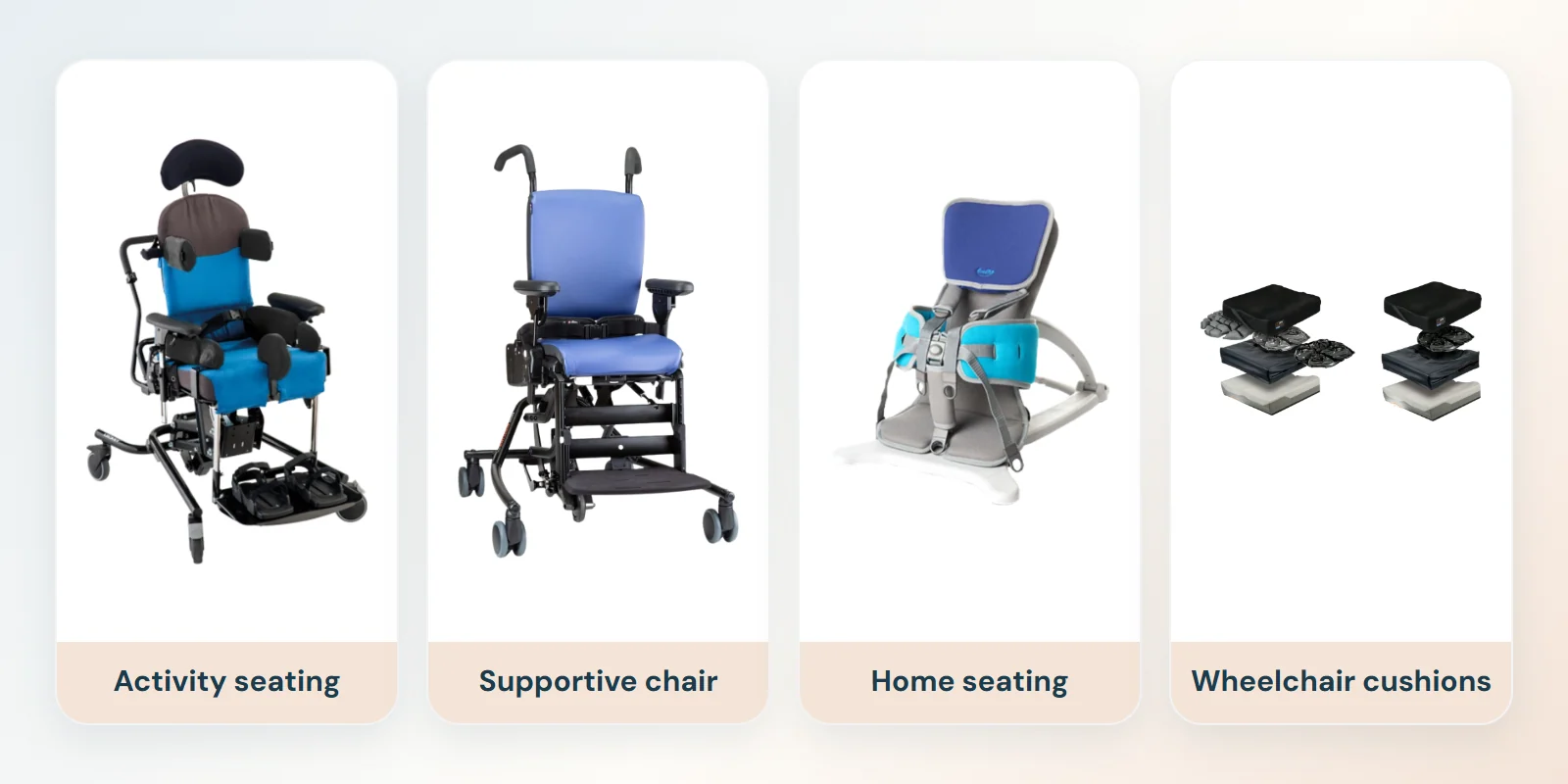
Indoor seating: Activity chairs or home seating for daily routines
Accessories: Additional supports based on individual needs
Positioning supports should be used thoughtfully and only when appropriate for the child’s safety, comfort and function.
A good recommendation should explain why a particular support is being suggested.
Parents should feel able to ask:
Support goal: What goal does this support address?
Daily benefit: How will this help my child during the day?
Main purpose: Is the support for comfort, posture, mobility, safety or participation?
Growth room: Can the equipment grow with my child?
Success signs: How will we know if the support is working?
Review timing: When should the equipment be reviewed?
The clearer the goal, the easier it is for everyone to understand the equipment decision.
What happens after the assessment?
The process may continue after the first assessment.
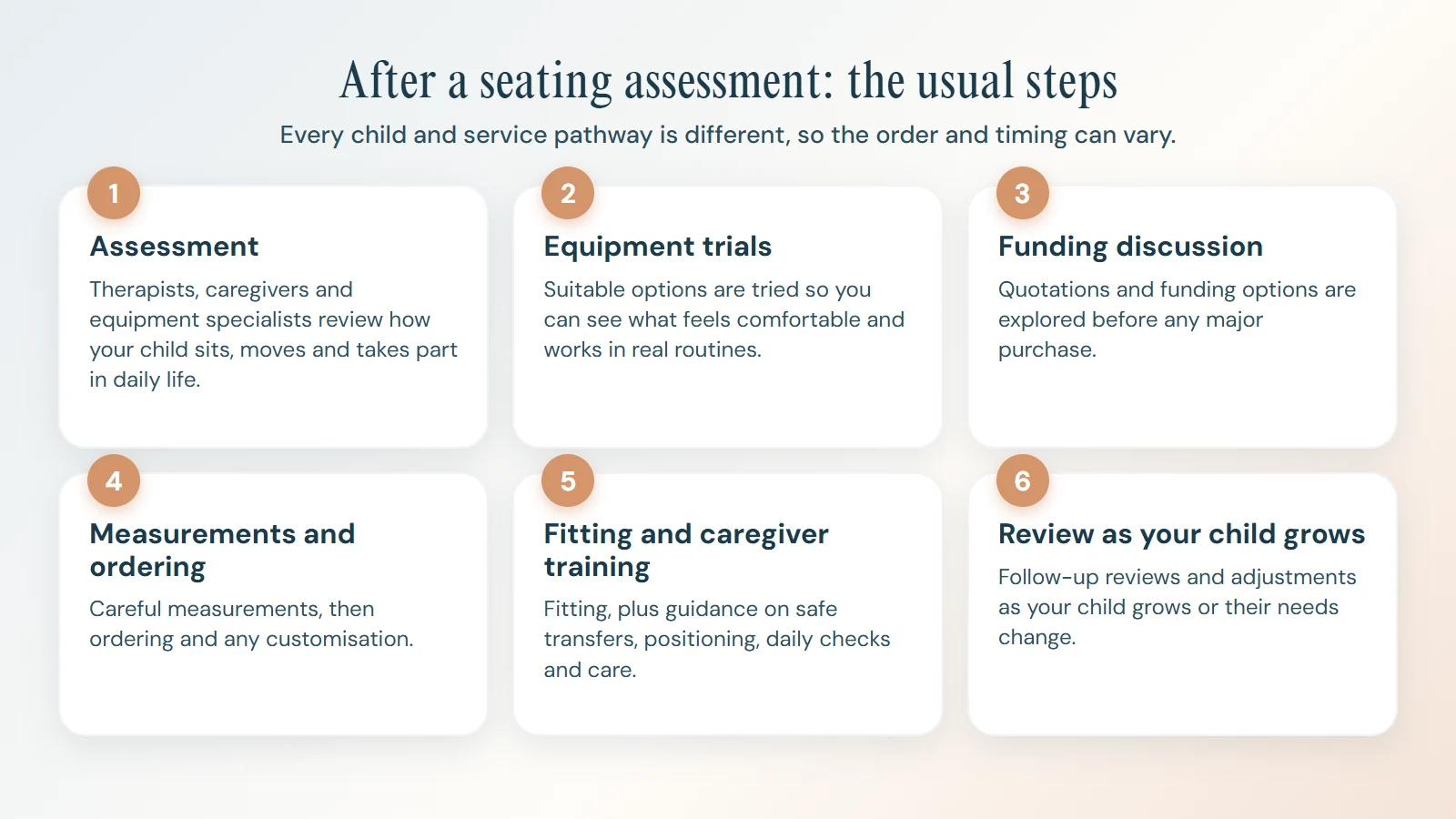
Depending on the child’s needs and the service pathway, the next steps may include equipment trials, quotation, funding discussion, measurements, ordering, customisation, fitting, caregiver training and follow-up review.
Fitting and training matter because good equipment is not useful if families are unsure how to use it safely.
Parents and caregivers may need guidance on:
Safe transfers: How to move the child in and out of the equipment
Positioning steps: How to place the child comfortably and consistently
Daily checks: What to look out for during regular use
Cleaning and care: How to maintain the equipment safely
Minor adjustments: What can be adjusted and what should be reviewed by the team
Growth signs: When the child may need refitting or reassessment
Safety reminders: How to use straps, supports, brakes and accessories appropriately
A child who has grown taller may need a different foot support position. A change in tone, fatigue, school routine or medical condition may also affect seating needs.
Review is normal.
Review does not mean the first decision was wrong. Review often means the child has grown, changed or entered a new stage of daily life.
Funding and Singapore support pathways
In Singapore, families may be able to explore funding support for assistive technology.
The Assistive Technology Fund may provide a subsidy of up to 90 percent of the cost of eligible assistive technology devices, subject to means testing and a lifetime cap of $40,000.
From January 2026, the monthly per capita household income threshold is listed as $4,800.
Funding should not be assumed, and approval is not automatic.
Applications may require assessment by a qualified assessor, supporting documentation and submission through relevant touchpoints such as public hospitals or social service agencies.
That is why it is helpful to discuss funding early, before committing to major equipment purchases.
Parents can ask their therapist, social worker, hospital team, early intervention provider or relevant support agency what options may apply to their child.
Where PSS fits in
At Paediatric Seating Solutions, we believe seating support should begin with the child, not the product.
PSS works alongside therapists, caregivers and families to support product selection, measurements, fitting, customisation and aftercare.
The best outcomes usually happen when equipment choices are guided by assessment and by a clear understanding of the child’s real daily needs.
Our role is not to replace medical or therapy advice.
Our role is to support the wider care team with equipment knowledge and practical fitting support, so the chosen solution fits the child’s body, routines and goals as well as possible.
A good seating journey should feel collaborative.
Parents should be heard. Therapists should be involved. The child’s comfort and participation should stay at the centre.
Seating is about more than sitting
A paediatric seating assessment is not about making a child look perfect in a chair.
It is about helping a child feel supported enough to eat, learn, rest, communicate, travel, play and take part in daily life.
Parents do not need to arrive with technical terms.
You only need to share what daily life looks like for your child: what is difficult, what matters most, what your child enjoys and what you hope will become easier.
The right seating support should fit the child, not the other way around.
When seating support is chosen with care, seating can become part of something much bigger than equipment.
Seating can help a child participate with more comfort, safety and dignity.
References
Cerebral Palsy Alliance Singapore. (n.d.). Seating and posture clinic. Retrieved November 13, 2026, from https://cpas.org.sg/seating-posture-clinic/
SG Enable. (n.d.-a). Assistive technology. Enabling Guide. Retrieved November 13, 2026, from https://enablingguide.sg/im-looking-for-disability-support/assistive-technology
SG Enable. (n.d.-b). Assistive Technology Fund. Enabling Guide. Retrieved November 13, 2026, from https://www.enablingguide.sg/im-looking-for-disability-support/assistive-technology/assistive-technology-fund
World Health Organization. (2023a). Recommendations and implementation guidance. In Wheelchair provision guidelines. https://www.ncbi.nlm.nih.gov/books/NBK600091/
World Health Organization. (2023b). Wheelchair provision guidelines. https://www.who.int/publications/i/item/9789240074521