


Child Mobility Support in Singapore: What a Diagnosis Means for Equipment
Written by Sabrina Lee

Child mobility support should begin with assessment, not a product list. A diagnosis can guide what doctors and therapists watch for, but equipment choices depend on how your child sits, stands, walks, tires, transfers, travels and participates in daily life.
Quick answer: A child’s diagnosis can explain movement, posture, strength, balance, fatigue or developmental concerns. However, the right mobility support depends on daily function, therapy goals, home routines, school access, transport needs and caregiver safety. Assessment helps families choose suitable support at the right time.
When your child receives a diagnosis, it is natural for your mind to fill with questions.
Will my child walk?
Will they need a wheelchair?
Should we get a walker, stander or supportive stroller?
What will they need for school, therapy, outings or daily care?
These are heavy questions. They often come with worry, urgency and uncertainty.
Many parents feel pressure to find answers quickly, especially when equipment is mentioned for the first time.
But a diagnosis does not automatically decide what mobility equipment your child needs.
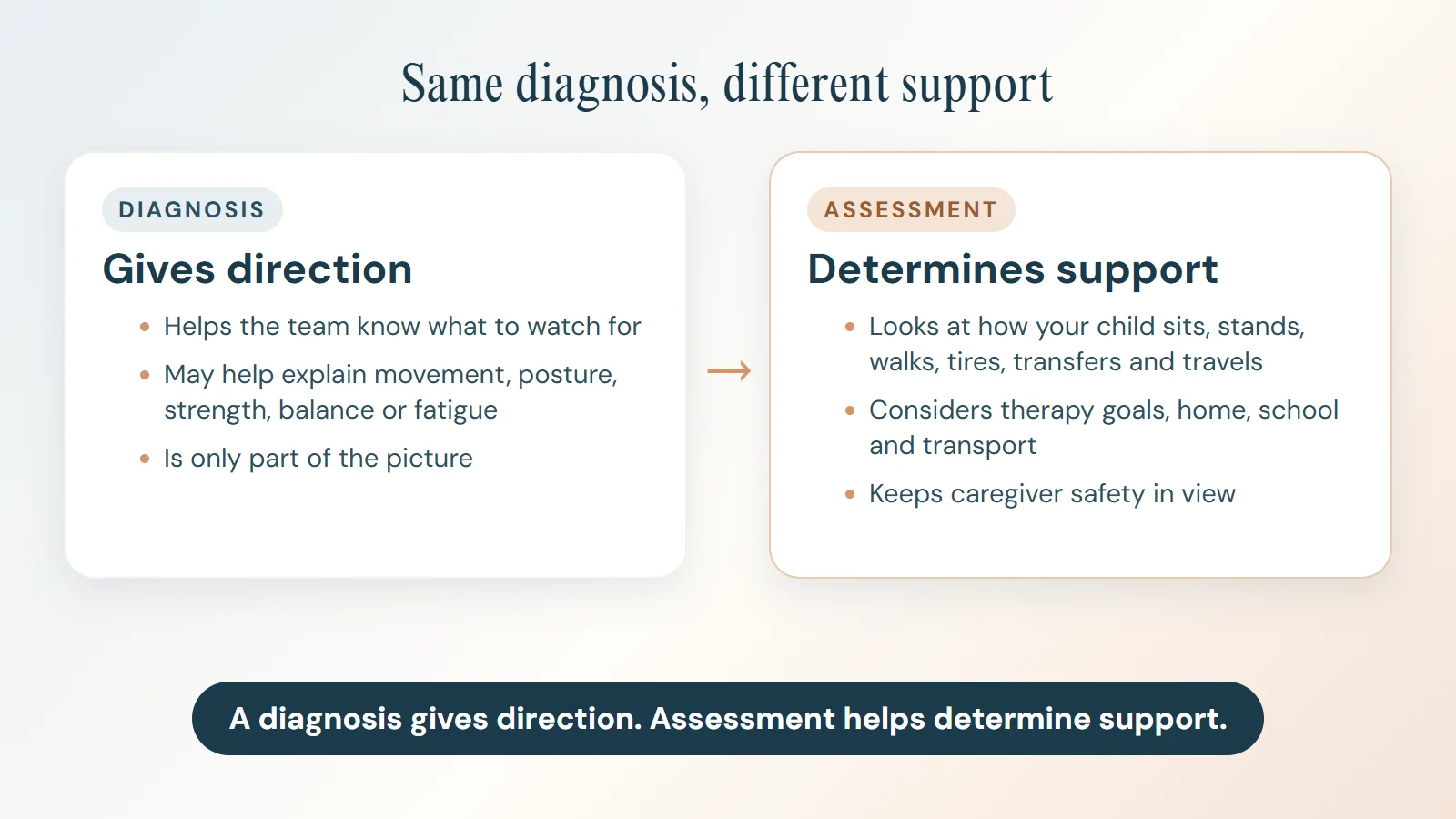
A diagnosis gives direction. Assessment helps determine support.
Diagnosis matters, but it is not the whole picture
A diagnosis can explain part of your child’s condition.
It may help you understand why your child finds certain movements difficult, why they tire easily, why they need support with posture, or why milestones such as sitting, standing or walking may look different.
But children are not defined by diagnosis labels.
Two children with the same diagnosis may have very different abilities, needs, routines and goals.
One child may walk independently but need rest breaks for longer outings. Another child may need a walker or gait trainer for therapy and practice.
Another child may need supportive seating, a stroller-style mobility base, a manual wheelchair, powered mobility or standing support.
This is why equipment decisions should be based on function, not diagnosis alone.
A diagnosis helps the team know what to watch for. An assessment helps the team understand what support your child needs in real life.
Same diagnosis, different support
Parents often ask, “If my child has this diagnosis, does that mean they will need this equipment?”
The honest answer is: not always.
For example, children with cerebral palsy can have very different movement abilities.
Some children may walk without mobility equipment but need help managing fatigue, balance or posture. Some children may use orthoses, walkers or gait trainers.
Some children may need supportive seating, tilt-in-space wheelchairs, powered mobility or transfer support.
Clinicians may use tools such as the Gross Motor Function Classification System, or GMFCS, to describe gross motor function in children with cerebral palsy.
GMFCS can help the care team talk about sitting, transfers, walking and mobility devices more clearly. Even then, the child’s daily environment, comfort, goals and family routines still matter.
For children with muscular dystrophy or other neuromuscular conditions, planning may look different because support needs can change over time.
Some children may need help conserving energy, maintaining comfort, supporting posture, accessing school or preparing for future mobility changes.
The key point is simple: the diagnosis is useful, but the diagnosis is not the final answer.
Your child’s actual needs must be understood through assessment, observation and discussion with the care team.
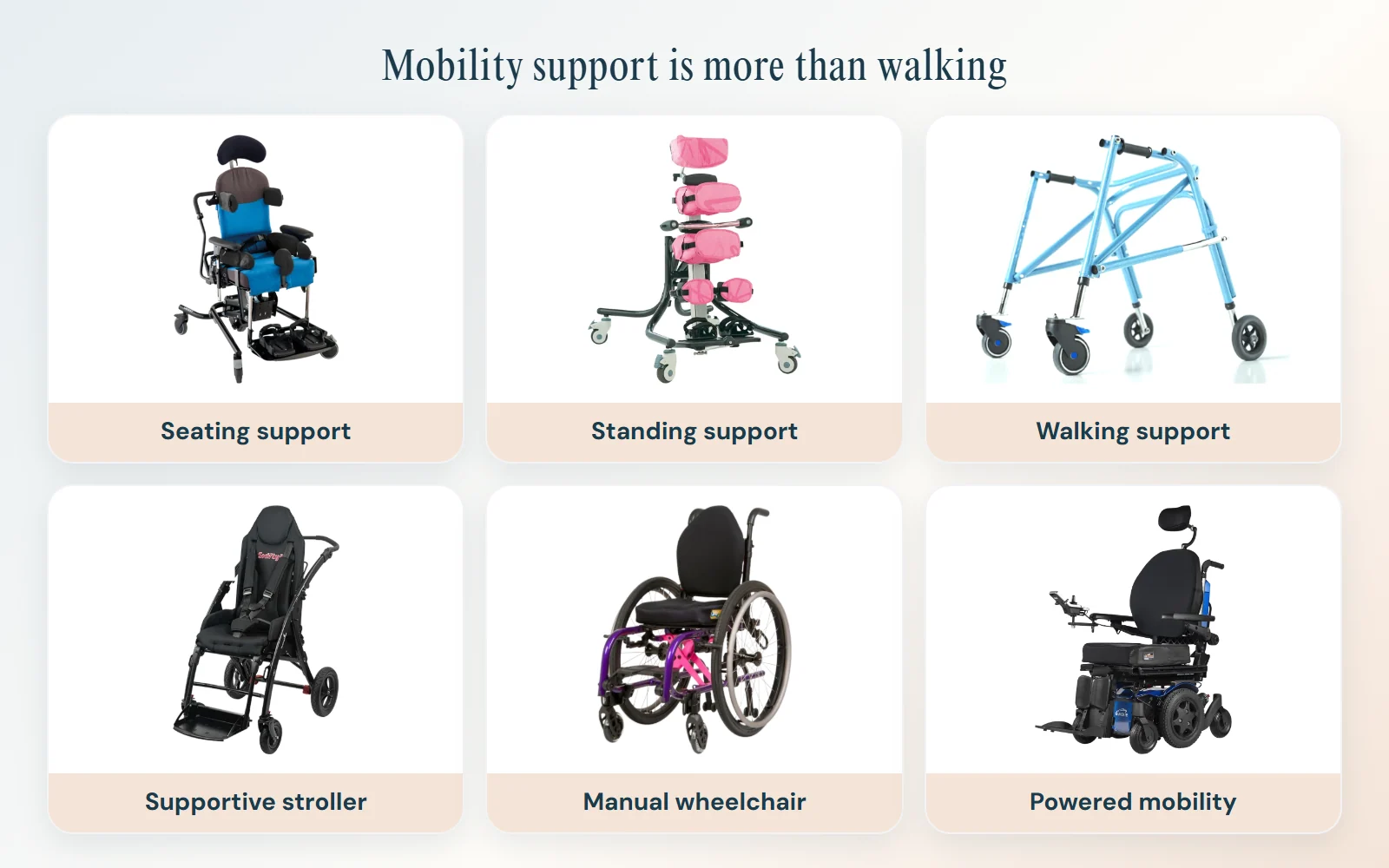
Mobility support is more than walking
When parents hear “mobility support”, they often think only about walking.
Walking is important, but mobility support is much broader than that.
Type of support | What it may help with |
|---|---|
Sitting comfort, posture, head control, hand use, feeding, learning and rest | |
Supported standing routines, therapy goals and positioning needs | |
Practice, balance, safety, gait training and confidence | |
Transport, community access, fatigue management and caregiver handling | |
Mobility, participation, school access and family outings | |
Independent movement when clinically appropriate | |
Orthoses or braces | Alignment, stability or physical support based on clinical assessment |
Safer movement between bed, chair, car, toilet or bath | |
Environmental changes | Ramps, access routes, home layout and safer movement through daily spaces |
Caregiver handling support | Safer and more manageable daily care routines |
Mobility support is not only about taking steps.
Mobility support is about helping your child access life.
That may mean having enough support to sit comfortably in class. It may mean conserving energy during a long school day.
It may mean joining family outings without becoming exhausted. It may mean moving safely in the community.
It may also mean giving caregivers a safer way to manage transfers and daily routines.
For some children, walking remains an active therapy goal. For others, the priority may be safe mobility, comfort, access and participation.
Both are valid.
Support does not mean giving up
Some parents worry that introducing a wheelchair, walker, stander or supportive stroller means their child is giving up.
That feeling is understandable.
Equipment can make a diagnosis feel more real.
But the right support is not the opposite of progress.
For many children, equipment can support independence, conserve energy, reduce unsafe fatigue, improve comfort, support school participation, make community access easier and help families manage daily routines more safely.
A wheelchair is not a failure.
A walker is not a sign that a child is not trying hard enough.
A stander is not simply a piece of equipment.
These supports can be part of a child’s wider therapy, care and participation plan when recommended appropriately.
The goal is not to use the most equipment possible.
The goal is to use the right support, at the right time, for the right reasons.
Function should come before product categories
Before choosing equipment, it helps to ask functional questions.
Parent question | Why it matters |
|---|---|
Can my child sit safely and comfortably? | Sitting support can affect learning, feeding, communication and play |
Can my child stand with or without support? | Standing goals should be guided by therapy and clinical suitability |
Can my child walk short distances, long distances or not yet? | Different walking abilities may need different support options |
Does my child tire easily? | Fatigue can affect school, therapy, outings and mood |
Are transfers safe for my child and caregivers? | Unsafe transfers can increase stress and injury risk |
Can my child access school, therapy and outings? | Mobility support should work in real environments |
Is my child in pain or discomfort? | Comfort should be part of every equipment discussion |
What does the therapist want to support? | Equipment should connect to therapy and participation goals |
What does our home, school and transport routine look like? | A suitable device must work in daily life, not only in a clinic |
These questions are more helpful than starting with a product list.
They help the care team understand what your child needs to do, what is difficult now and what support may help.
For example, if your child can walk short distances but becomes very tired during long outings, the solution may not be to stop walking practice.
The solution may be to explore a mobility option that helps your child conserve energy for the parts of the day that matter most.
If your child struggles to sit upright, the first question may not be which wheelchair to buy.
The first question may be whether your child needs better pelvic, trunk, head or foot support so they can eat, learn, communicate and play more comfortably.
Good equipment decisions begin with daily life.
Why assessment matters before equipment selection
Assessment-led planning is the safest and most responsible direction.
In Singapore, assistive technology assessment helps identify suitable devices based on the child’s needs, abilities, limitations, intended tasks and environment.
This may be carried out by therapists in hospitals, social service agencies or other relevant service settings.
For seating, positioning and mobility needs, assessment may look at:
Posture: How your child sits, stands or moves
Movement: How your child changes position or moves through space
Pressure areas: Whether sitting or positioning creates discomfort or redness
Balance: How much support your child needs to remain stable
Strength and fatigue: How effort, endurance and tiredness affect daily life
Pain or discomfort: Whether support is needed for comfort and safety
Transfers: How your child moves in and out of equipment
Caregiver handling: How safely and realistically caregivers can manage routines
Home layout: Whether equipment fits the family’s space
School use: Whether the support works for learning and classroom routines
Transport needs: Whether the equipment fits travel and outing routines
Participation goals: How your child can join daily activities more comfortably
This matters because equipment affects more than movement.
A device that looks suitable online may not support your child’s posture well. It may be hard to use at home.
It may not fit the family car. It may not meet school requirements.
It may not allow safe transfers. It may not grow with your child.
It may be too supportive in one area and not supportive enough in another.
Assessment helps reduce guesswork. It also helps families avoid rushed purchases that may become unsuitable, uncomfortable or difficult to use.
Singapore pathways parents may encounter
If your child is young and has developmental needs, you may hear about the Early Intervention Programme for Infants and Children, or EIPIC.
EIPIC supports children from birth to six years old who require medium to high levels of early intervention support.
It is open to Singapore Citizen and Permanent Resident children who meet the programme’s eligibility criteria.
EIPIC is not an equipment programme.
However, it can help families enter a support pathway where therapy goals, developmental needs and caregiver concerns can become clearer.
Depending on your child’s needs, you may also work with therapists in hospitals, early intervention centres, social service agencies, special education schools, seating and posture clinics, or assistive technology services.
There is no need to understand every pathway immediately.
Start with the professionals already involved in your child’s care and ask what the next appropriate assessment should be.
Funding should be explored early
Equipment can be costly, so it is wise to ask about funding before making major purchases.
In Singapore, the Assistive Technology Fund may help eligible persons with disabilities defray the cost of buying, replacing, upgrading or repairing assistive technology devices.
The fund may subsidise up to 90 percent of eligible costs, subject to means testing and a lifetime cap of $40,000.
From January 2026, the monthly per capita household income threshold is listed as $4,800.
Funding is not automatic.
Applications may require assessment by a qualified assessor, supporting documents, eligibility checks and submission through recognised touchpoints.
Before committing to major mobility or seating equipment, speak with your therapist, social worker, hospital team, early intervention provider or relevant support agency.
They can guide you on what documentation may be needed and whether your child may be eligible.
Progressive and non-progressive conditions need different planning
Some conditions are described as non-progressive, while others may be progressive.
This can affect how mobility support is planned.
Cerebral palsy, for example, is commonly described as involving permanent, non-progressive abnormalities affecting movement and posture. However, a child’s functional challenges, posture, pain, fatigue and participation needs can still change as the child grows.
Muscular dystrophy and some neuromuscular conditions may involve progressive weakness.
This means mobility planning may need to consider present needs as well as likely future changes.
Support such as braces, seating, powered mobility, school access or transport planning may become relevant at different stages.
This does not mean parents should panic or plan for every possible future issue at once.
It means review is part of good care.
Children grow. School routines change. Therapy goals change. Home routines change.
Support needs may change too.
A mobility aid that is right today may need adjustment later, and that is normal.
Parents are part of the assessment team
Therapists bring clinical knowledge, but parents know the child’s daily reality.
You see what happens in the morning rush, during meals, in the car, after school, at therapy, in the playground, during outings and at bedtime.
You know when your child is tired, frustrated, excited, uncomfortable or more willing to try.
Your observations matter.
Before a mobility or equipment discussion, it may help to think about:
Current ability: What can your child do now?
Difficult moments: What feels difficult, unsafe or tiring?
Fatigue patterns: When does your child get tired?
Support areas: Where is support most needed?
Therapy goals: What school or therapy goals matter?
Transport routines: How does your child travel?
Transfer challenges: Which transfers are difficult?
Child preferences: What does your child enjoy or avoid?
Family capacity: What can the family realistically manage?
Equipment tolerance: What equipment does your child accept or reject?
A good recommendation should fit your child’s body.
It should also fit home, school and family life.
Where PSS fits in
At Paediatric Seating Solutions, we believe equipment should be chosen around the child, not around the diagnosis.
PSS works alongside therapists, caregivers and families to help match equipment to the child’s body, routines, environment and goals.
This may involve seating, mobility, standing, walking, positioning or transport-related support, depending on what has been assessed as appropriate.
Our role is not to replace medical or therapy advice.
The best outcomes happen when equipment decisions are guided by assessment, therapist input and honest caregiver feedback.
We are here to help families understand options, support fitting and customisation, and make the equipment journey feel clearer and more manageable.
The focus should always remain on the child.
Not the product. Not the label. Not what another child with the same diagnosis uses.
Your child’s support should be built around your child’s life.
Your child is more than the diagnosis
A diagnosis can feel overwhelming at first.
It may raise questions about movement, independence, school, care routines and the future.
But your child is more than a diagnosis.
Your child has preferences, personality, strengths, frustrations, joys and goals.
Mobility support should not define your child’s limits.
When chosen carefully, mobility support can open more ways for your child to participate.
The right support can help a child move safely, sit comfortably, conserve energy, access learning, join play, travel with family and take part in daily life with more dignity.
Start with assessment. Ask practical questions. Share what daily life really looks like.
Build the right team around your child.
You do not need to solve everything today.
You only need to take the next right step.
References
CanChild. (n.d.). Gross Motor Function Classification System – Expanded & revised (GMFCS – E&R). McMaster University. Retrieved November 13, 2026, from https://canchild.ca/en/resources/42-gmfcs-e-r
Cerebral Palsy Alliance Singapore. (n.d.). Seating and posture clinic. Retrieved November 13, 2026, from https://cpas.org.sg/seating-posture-clinic/
Early Childhood Development Agency. (2026, April 21). Early Intervention Programme for Infants and Children (EIPIC). https://ecda.gov.sg/parents/other-services/early-intervention-services/early-intervention-programme-for-infants-and-children-(eipic)
National Institute for Health and Care Excellence. (2017). Cerebral palsy in under 25s: Assessment and management (NICE Guideline No. NG62). https://www.nice.org.uk/guidance/ng62
Sengupta, S.. (n.d.). Seating goals for a child with muscular dystrophy. Muscular Dystrophy Association (Singapore). Retrieved November 13, 2026, from https://www.mdas.org.sg/resource-families-caregivers/seating-goals-for-a-child-with-muscular-dystrophy/
SG Enable. (n.d.-a). Assistive technology. Enabling Guide. Retrieved November 13, 2026, from https://enablingguide.sg/im-looking-for-disability-support/assistive-technology
SG Enable. (n.d.-b). Assistive Technology Fund. Enabling Guide. Retrieved November 13, 2026, from https://www.enablingguide.sg/im-looking-for-disability-support/assistive-technology/assistive-technology-fund
SG Enable. (n.d.-c). Early Intervention Programme for Infants & Children (EIPIC) and Development Support Plus (DS-Plus). Enabling Guide. Retrieved November 13, 2026, from https://enablingguide.sg/im-looking-for-disability-support/therapy-intervention/early-intervention-programme-for-infants-children
World Health Organization. (2023a). Recommendations and implementation guidance. In Wheelchair provision guidelines. https://www.ncbi.nlm.nih.gov/books/NBK600091/
World Health Organization. (2023b). Wheelchair provision guidelines. https://www.who.int/publications/i/item/9789240074521