


Occupational Therapist vs Physiotherapist: Why Both Matter for Your Child’s Equipment
Written by Sabrina Lee

Occupational Therapist vs Physiotherapist is a common question for parents choosing paediatric equipment in Singapore. An Occupational Therapist, or OT, often focuses on daily activities and participation, while a Physiotherapist, or PT, often focuses on posture, movement, strength, mobility and physical function.
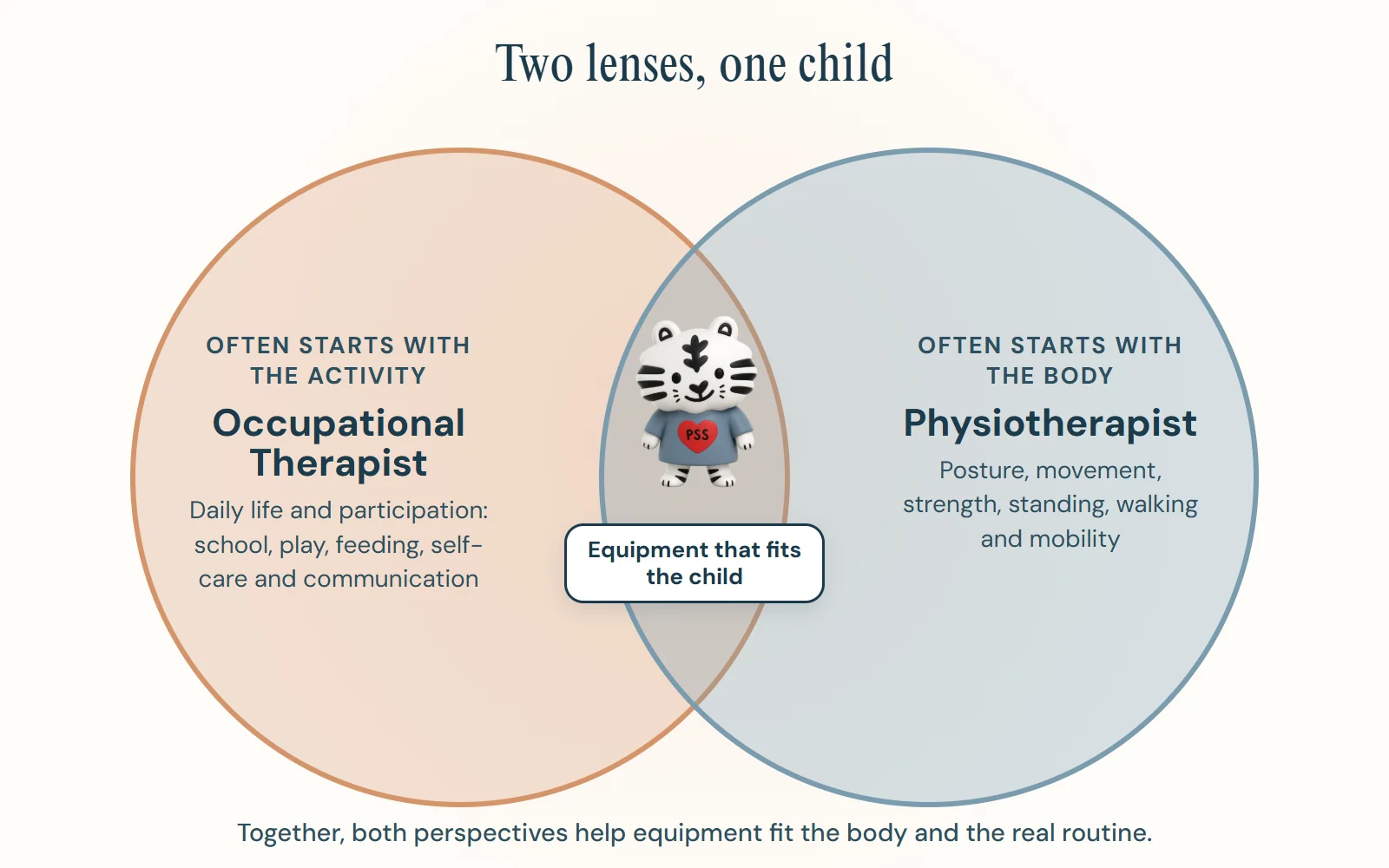
Quick answer: An Occupational Therapist helps assess how equipment supports your child’s daily life, such as school, play, feeding, self-care and communication. A Physiotherapist helps assess how equipment supports your child’s body, movement, posture, standing, walking and mobility. Both perspectives matter because equipment must fit the child’s body and real routine.
When your child needs equipment, you may hear many professional titles.
Occupational Therapist. Physiotherapist. Doctor. Social worker. Equipment provider. Assistive technology assessor.
It can feel confusing at first.
From the outside, an OT and PT may seem to do similar things. Both may look at posture, movement, transfers, comfort, safety and equipment use.
But they often ask different questions.
The OT looks closely at what your child needs to do each day. The PT looks closely at how your child’s body moves and is supported while doing those activities.
Together, these two lenses can help your child’s equipment fit more than a measurement. Equipment should fit your child’s body, routines, environment, goals and family life.
First, the right term is Physiotherapist
For this topic, the more accurate term is Physiotherapist, not Physiologist.
In Singapore paediatric equipment, seating and mobility settings, families are more likely to work with Occupational Therapists and Physiotherapists.
A physiologist is a different type of professional and is not usually the person parents are referring to when discussing paediatric seating, mobility aids, standing frames, walkers or child equipment assessments.
Occupational Therapists and Physiotherapists are both regulated allied health professionals in Singapore.
That means both professions have recognised roles in supporting health, function, rehabilitation and daily participation.
The simple difference: the day and the body
A helpful way to understand OT and PT is this:
Professional | Main lens | Simple parent explanation |
|---|---|---|
Occupational Therapist | Daily life and participation | How can this equipment help my child eat, learn, play, communicate, travel and manage daily routines? |
Physiotherapist | Body movement and physical function | How can this equipment support my child’s posture, strength, balance, movement, standing, walking and mobility? |
This is not a hard line.
In real paediatric practice, OT and PT roles often overlap. Both may care about posture, movement, transfers, comfort, safety and independence.
The difference is usually the main question each therapist is trained to ask.
The OT may ask: How will this support your child’s daily activities?
The PT may ask: How will this support your child’s body and movement goals?
Both questions matter.
Why equipment is not just a product choice
Parents may think equipment selection is mainly about choosing a wheelchair, stroller, stander, walker, seating system or special chair.
But paediatric equipment is part of a wider support plan.
A device can affect posture, comfort, mobility, hand use, feeding, transfers, school participation, transport, fatigue, safety and caregiver handling.
This is why therapist input matters before major equipment decisions.
A seating system may support posture, but it may also affect hand use, table access, communication and feeding.
A walker may support movement, but it may also affect fatigue, safety and confidence.
A stander may support physical goals, but it also needs to fit the home, school, therapy routine and caregiver workflow.
A wheelchair or supportive stroller may help with community mobility, but it must also work for transfers, transport, pressure care and comfort.
Good equipment is not only about choosing the right product.
Good equipment is about choosing the right support for the child’s real life.
What an Occupational Therapist may look at
An Occupational Therapist often focuses on how your child participates in daily activities.
For paediatric equipment, the OT may consider how a seating system, wheelchair, stroller, stander, walker, activity chair or assistive technology device supports your child’s function and independence.
The OT may look at:
School participation: Can your child sit comfortably for classroom activities?
Table access: Can your child reach a table, tray, toy, book or learning device?
Hand use: Can your child use their hands for play, communication, feeding or school tasks?
Feeding routines: Does your child need better support during meals or tube feeding routines?
Self-care: Can equipment support dressing, bathing, toileting or hygiene routines?
Communication access: Can your child access switches, AAC tools, eye gaze systems or other communication supports?
Play and leisure: Can your child join activities with siblings, classmates and family members?
Home environment: Will the equipment fit through doorways, around furniture and into daily routines?
Caregiver handling: Can caregivers use the equipment safely and realistically every day?
Assistive technology use: Does your child need tools that support access, learning or independence?
The OT’s role is not only to ask whether equipment fits your child’s body.
The OT also asks whether the equipment fits your child’s day.
What a Physiotherapist may look at
A Physiotherapist often focuses on movement, posture, strength, balance, mobility and physical function.
For paediatric equipment, the PT may consider how a device supports your child’s body safely and appropriately.
The PT may look at:
Posture: How is your child’s body positioned when sitting, standing or moving?
Head control: Does your child need support to hold their head safely and comfortably?
Trunk control: Can your child maintain an upright or supported position?
Pelvis and hips: Does your child need support for alignment, comfort or stability?
Leg and foot support: Are the legs and feet positioned in a way that supports the whole body?
Muscle tone: Does high or low tone affect sitting, standing, walking or transfers?
Strength and balance: What support does your child need for safe movement?
Range of motion: Are there physical limitations that affect positioning or mobility?
Transfers: How does your child move in and out of equipment?
Standing: Would a standing frame or supported standing programme be appropriate?
Walking and gait: Would a walker, gait trainer or mobility aid support movement goals?
Mobility safety: Is the equipment supporting movement without creating unnecessary risk?
The PT’s role is not only to ask whether your child can move.
The PT also asks how your child’s body is supported while moving, sitting, standing or resting.
Why both perspectives matter
Children are not separate parts.
A child’s body affects daily life. A child’s daily routines affect how the body is used.
That is why OT and PT input can be so helpful when choosing paediatric equipment.
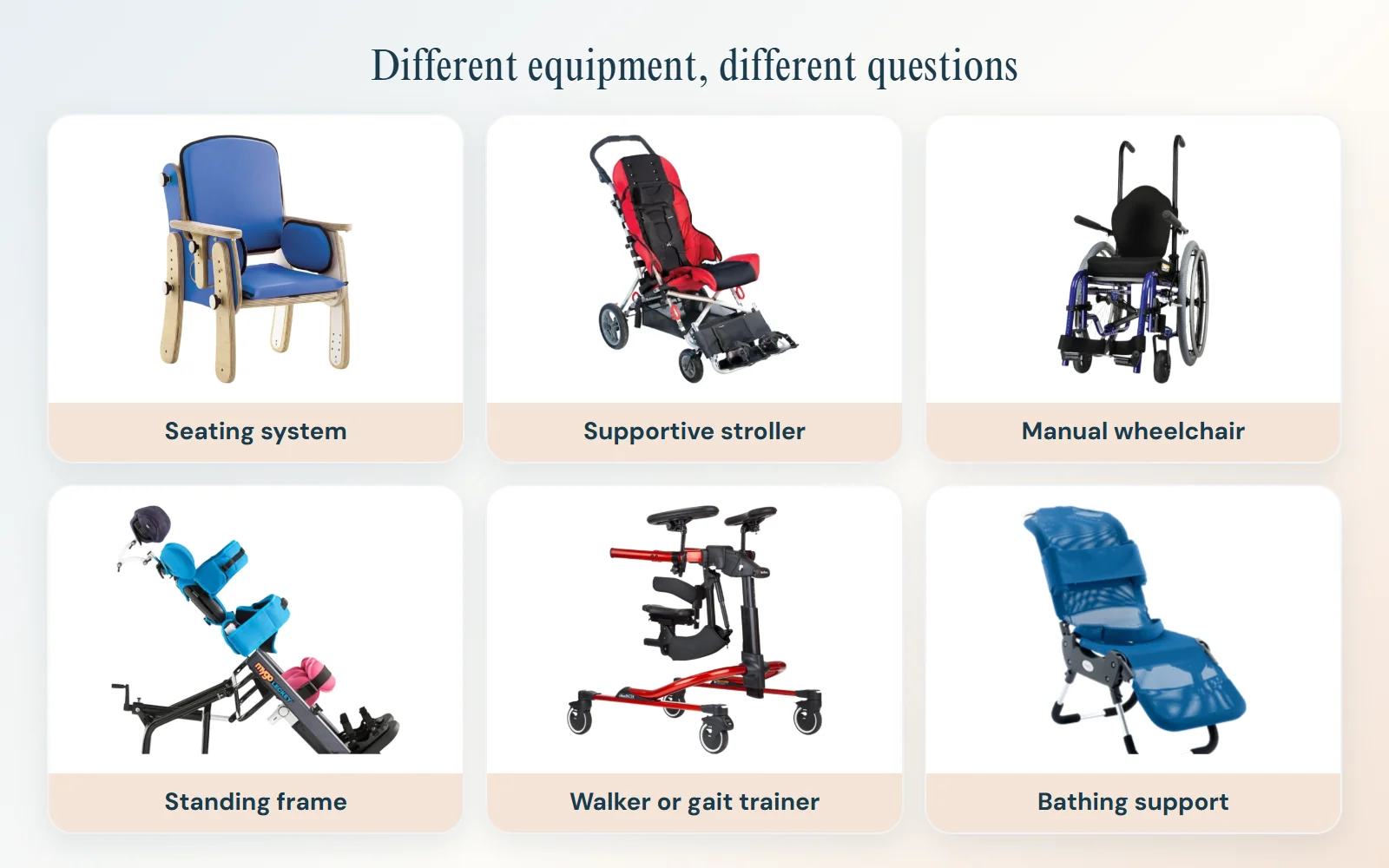
Equipment example | OT perspective | PT perspective |
|---|---|---|
Can the child use their hands, access a tray, eat, learn and participate? | Is the pelvis, trunk, head, legs and feet supported safely and comfortably? | |
Does it fit family outings, transport, school runs and caregiver routines? | Does it provide enough postural support, comfort and fatigue management? | |
Can the child participate at school, home and community settings? | Is the chair suitable for mobility, posture, propulsion and physical function? | |
Can standing fit into the child’s daily routine meaningfully? | Is supported standing appropriate for posture, alignment and physical goals? | |
Can the child access activities and practise movement in real environments? | Does it support balance, gait, strength, endurance and safety? | |
Can caregivers manage hygiene routines safely and practically? | Are transfers, posture and physical support safe during the routine? |
This is why parents should not feel they need to choose between OT and PT.
For some simpler needs, one therapist may be enough.
For more complex seating, mobility, standing, walking, postural or assistive technology needs, both perspectives may help reduce blind spots.
Too little support and too much support can both be a problem
The right equipment often needs balance.
Too little support may leave a child tired, unstable, uncomfortable or unsafe.
Too much support may make it harder for a child to move, explore, use their hands, communicate or practise functional skills.
This is where OT and PT perspectives can work well together.
The PT may consider stability, alignment, muscle tone, posture and movement.
The OT may consider whether the same setup still supports play, hand use, learning, communication, feeding, self-care and independence.
The goal is not to hold a child in one fixed position for the sake of appearance.
The goal is to give enough support for comfort and safety, while still allowing meaningful participation where possible.
What if OT and PT roles overlap?
OT and PT roles can overlap, especially in paediatrics.
That is normal.
Both therapists may observe how your child sits, moves, transfers, uses equipment and responds to support.
Both may care about safety, comfort, independence, caregiver handling and participation.
The difference is not always a strict boundary. It is more about the main lens.
The OT often starts with the activity and asks how the child can participate.
The PT often starts with the body and asks how movement and physical function can be supported.
When both perspectives come together, the recommendation can become more complete.
Do parents need to choose who to see first?
Parents are not expected to know whether their child needs OT input, PT input or both.
A good care team should help guide that decision.
Some children may already be seeing one therapist regularly. That therapist may suggest whether another perspective is needed.
For more complex seating, mobility or positioning decisions, it may be helpful for both OT and PT input to be considered.
In Singapore, CPAS’ Seating and Posture Clinic is one example of a service model where clients are evaluated by both an Occupational Therapist and Physiotherapist before decisions are made with parents or caregivers on special seating, positioning equipment or mobility devices.
That does not mean every child must always see both therapists for every equipment decision.
It means that for more involved equipment needs, different professional lenses can help families make safer, clearer and more practical choices.
Common parent questions
Aren’t OT and PT basically the same?
They are not the same, but their work can overlap.
Both may care about posture, movement, function and safety. The OT usually focuses more on daily activities, participation, self-care, play, school, environment and assistive technology use.
The PT usually focuses more on movement, mobility, physical function, posture, strength, balance, gait and rehabilitation.
If one therapist recommends equipment, why involve another?
Sometimes one therapist may be enough.
However, complex equipment can affect many areas at once. A second professional lens may help the team notice issues that are not obvious at first.
For example, a setup that supports posture well may still need adjustment if it limits hand use, communication or classroom access.
Will involving both make the process slower?
It may add steps.
But careful input can help reduce guesswork and avoid rushed equipment decisions.
A poorly matched device can be uncomfortable, hard to transport, difficult for caregivers to use or unsuitable for school and home routines.
What if therapists disagree?
Different views are not always a bad thing.
A PT may prioritise alignment, stability and movement goals. An OT may ask whether the setup still supports play, feeding, learning, communication or daily independence.
When these tradeoffs are discussed clearly, the team can make a more thoughtful recommendation.
Is equipment only about mobility?
No.
Equipment can support sitting, standing, walking, feeding, school participation, bathing, toileting, transport, rest, pressure care, caregiver handling and independence.
Mobility is only one part of your child’s day.
Therapist input can also matter for funding
In Singapore, funding routes such as the Assistive Technology Fund may require assessment and documentation.
The Assistive Technology Fund may provide a subsidy of up to 90 percent of the cost of eligible assistive technology devices, subject to means testing and a lifetime cap of $40,000.
From January 2026, the monthly per capita household income threshold is listed as $4,800.
Applicants also need to undergo assessment by an assessor, such as a therapist, to determine the need and type of assistive technology device.
This does not mean funding is guaranteed.
Eligibility, documentation, assessment and application requirements still apply. Parents should speak with their therapist, social worker, hospital team or relevant touchpoint before committing to major equipment purchases.
Therapist input is therefore not only clinically useful.
It can also be practically important when families are exploring funding support.
How parents can be part of the team
Parents are not passive observers in the equipment journey.
You know your child’s daily life in a way no clinic appointment can fully capture.
You can help the OT, PT and equipment team by sharing:
What works: What positions, routines or supports help your child?
What is difficult: When does your child seem tired, uncomfortable or unsafe?
Where equipment is used: Will the equipment be used at home, school, therapy, transport or community outings?
When problems happen: Does your child struggle more during meals, travel, school or later in the day?
Caregiver concerns: Which transfers, routines or handling tasks feel difficult?
Child preferences: What does your child enjoy, dislike or tolerate well?
Family goals: What would make daily life safer, easier or more meaningful?
Your observations matter.
A child may sit differently at home than in a clinic. A device may look suitable in a trial but feel difficult during transport.
A setup may support posture but not fit the family’s routine.
Parent input helps the team choose equipment that is realistic, usable and centred on the child’s life.
Where PSS fits in
At Paediatric Seating Solutions, we believe equipment should be chosen around the child, not just around the product.
PSS works alongside therapists, caregivers and families to support product selection, measurements, fitting, customisation and aftercare.
Our role is not to replace medical or therapy advice.
Our role is to help the wider care team translate assessed needs into practical equipment solutions that fit the child’s body, routines, environment and goals.
The best outcomes usually happen when everyone works together: the child, family, OT, PT, medical team, social worker where needed and equipment specialist.
A good equipment journey should feel collaborative.
Parents should be heard. Therapists should be respected. The child’s comfort, safety and participation should remain at the centre.
Two lenses, one child
An Occupational Therapist and a Physiotherapist may look at the same child and notice different things.
That is not confusing when you understand the purpose.
The OT helps the team see how equipment supports the child’s day.
The PT helps the team see how equipment supports the child’s body.
Together, both perspectives can help equipment fit the child more fully.
Not only in the clinic.
Not only on paper.
But in the everyday moments that matter most: sitting, standing, moving, learning, eating, playing, travelling, communicating and taking part in family life.
That is why both OT and PT input can matter for your child’s equipment.
Because the goal is not simply to choose a device.
The goal is to support your child with more comfort, safety, dignity and participation.
References
Allied Health Professions Council. (2025, April 7). Registers of allied health professionals. https://www.ahpc.gov.sg/for-professionals/registers-of-allied-health-professionals/
Cerebral Palsy Alliance Singapore. (n.d.). Seating and posture clinic. Retrieved November 13, 2026, from https://cpas.org.sg/seating-posture-clinic/
SG Enable. (n.d.-a). Assistive technology. Retrieved November 13, 2026, from https://www.sgenable.sg/your-first-stop/accessibility-assistive-technology/assistive-technology
SG Enable. (n.d.-b). Assistive Technology Fund. Enabling Guide. Retrieved November 13, 2026, from https://www.enablingguide.sg/im-looking-for-disability-support/assistive-technology/assistive-technology-fund
Singapore General Hospital. (n.d.). What is the difference between occupational therapy and physiotherapy? AHPedia. Retrieved November 13, 2026, from https://ask.gov.sg/sgh-ahpedia/questions/cmeqy6tpw00h7f2j10ewfby0w