



Paediatric Equipment in Singapore: Where Parents Can Begin After a Child’s Diagnosis
By Sabrina Lee
Paediatric equipment in Singapore can include wheelchairs, supportive strollers, seating systems, standing frames, walking aids, bath chairs and assistive technology for children with disabilities or developmental needs. After a child receives a diagnosis, the safest starting point is not shopping. The safest starting point is assessment.
Quick answer: If your child has just been diagnosed, begin by understanding your child’s daily support needs before buying equipment. Speak with your child’s doctor, therapist or early intervention team, then explore suitable paediatric equipment, assistive technology assessment and funding options with proper professional guidance.
When your child first receives a diagnosis, it is natural to want answers immediately.
What equipment does my child need?
Should we buy a wheelchair, stroller, stander, walker or special chair?
What if we wait too long, or choose the wrong product?
These questions often come from love, worry and the instinct to protect your child as quickly as possible. But specialist paediatric equipment should support more than a diagnosis on paper.
It should support your child’s body, routine, comfort, safety and growth. It should also support caregivers, because daily care needs to be safe and manageable for the family too.
You do not need to figure everything out in one day. You are not expected to do this alone.
Start with assessment, not shopping
After a diagnosis, many parents begin by searching online for equipment. Seeing product names can feel like taking action.
That response is completely understandable. But specialist paediatric equipment is not the same as ordinary baby gear.
A wheelchair, seating system, stander, walker, bath chair or supportive stroller can affect your child’s posture, breathing comfort, skin pressure, head position, hip position, transfers, mobility and participation.
The wrong choice may be uncomfortable. It may not suit your home, transport routine or caregiver capacity. It may also fail to match what your child needs at their current stage.
Before asking, “What should I buy?”, a better first question is:
What does my child need support with each day?
That question helps doctors, therapists and equipment providers look beyond a product category. The focus becomes your child as a whole person, not just the equipment.
Build your child’s support circle first
A new diagnosis can make parents feel as if they suddenly need to understand everything at once.
Therapy, mobility, posture, school readiness, funding, equipment, caregiving and long-term planning can feel overwhelming in the beginning.
You do not need to become an expert overnight.
In Singapore, families may be guided by paediatricians, hospitals, early intervention professionals, occupational therapists, physiotherapists, speech therapists, social workers, SG Enable-linked services, assistive technology assessors and condition-specific organisations.
Each professional plays a different role.
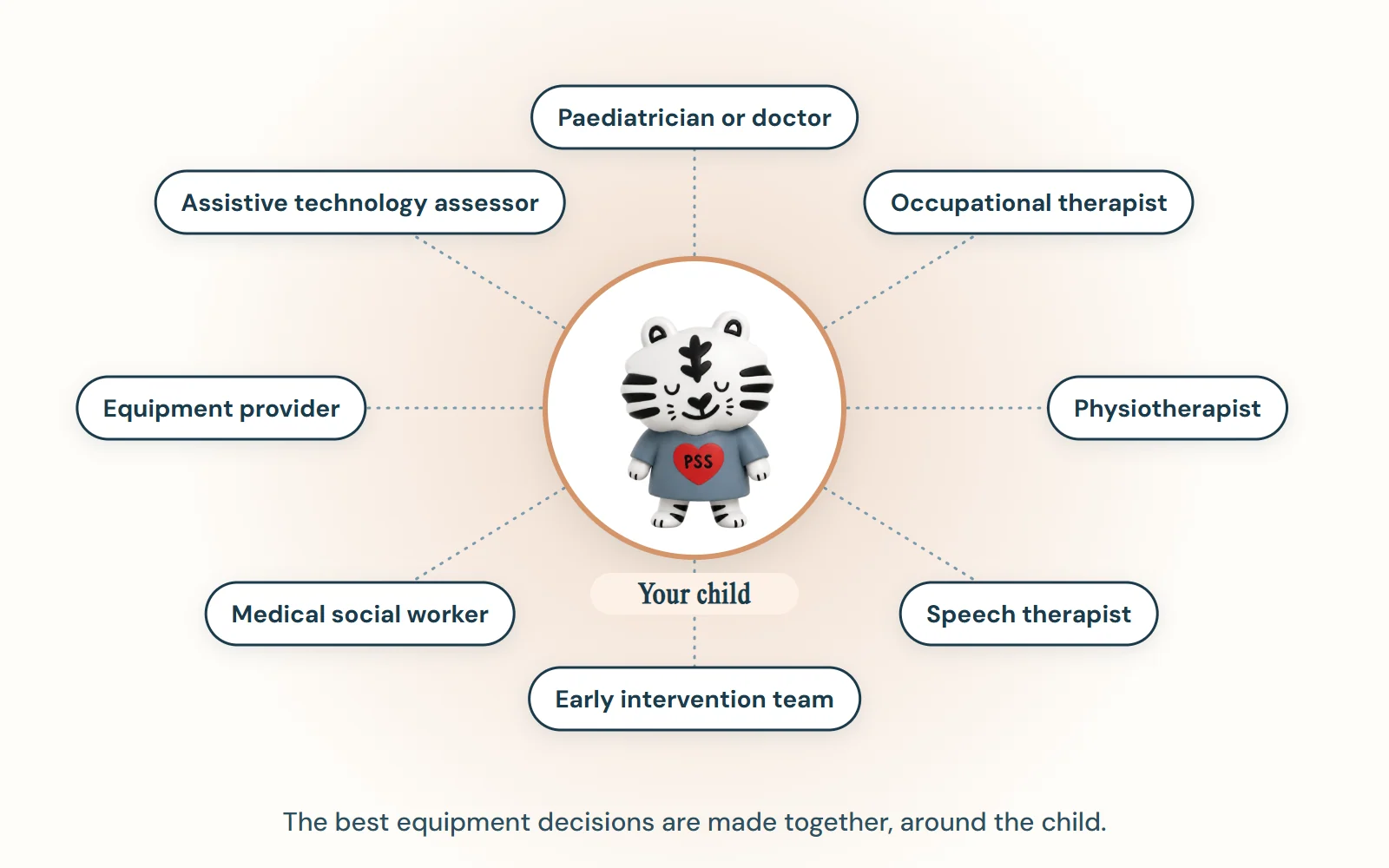
Support person or service
Possible role in your child’s journey
Paediatrician or doctor
Assesses medical and developmental concerns, provides referrals and recommendations
Occupational therapist
Looks at daily function, seating, positioning, self-care, play, access and caregiver routines
Physiotherapist
Assesses movement, posture, standing, walking, strength, balance and mobility goals
Speech therapist
Supports feeding, swallowing, communication and access to communication tools
Early intervention team
Helps set developmental goals and support learning through daily routines
Medical social worker
Guides families through financial assistance, funding and service applications
Assistive technology assessor
Recommends suitable devices based on the child’s needs, environment and tasks
Equipment provider
Works with the therapy team and family to match, fit and adjust suitable equipment
The goal is not to collect as many opinions as possible. The goal is to bring the right people around your child, so equipment decisions are made with care.
An equipment provider should work alongside your child’s support circle. The equipment provider should not replace clinical assessment or therapy guidance.
Understand Singapore’s early intervention pathway
For young children in Singapore, early intervention can be an important starting point.
The Early Intervention Programme for Infants and Children, or EIPIC, supports children who require medium to high levels of early intervention support. It is delivered through early intervention centres by early intervention professionals and allied health professionals.
For government-funded early intervention services, parents and caregivers may begin by visiting a doctor at a polyclinic. The doctor can refer the child for assessment at KKH’s Department of Child Development or NUH’s Child Development Unit.
Families may also approach a private paediatrician for assessment and recommendation.
If the child is assessed to be suitable, the hospital or paediatrician can submit an application to SG Enable. SG Enable will contact the family with information on choosing an early intervention centre. The preferred centre will then contact the family to arrange the next steps, subject to vacancies and approval.
EIPIC is not an equipment programme. However, it can help families enter a wider support ecosystem where therapy goals, developmental needs and caregiver support become clearer.
Important note on EIPIC-P
As of November 2026, new referrals for EIPIC-P have been temporarily suspended since 1 June 2026, while the Early Childhood Development Agency conducts an open selection process to appoint EIPIC-P operators from January 2027. Referrals will resume in early 2027. Children already enrolled in EIPIC-P programmes continue to receive subsidised services.
This notice applies specifically to EIPIC-P. Parents should check the latest official information before making plans, because early intervention service details can change.
Speak with your child’s therapy team
Equipment decisions are usually strongest when they are guided by therapy goals.
For example, your child may need support for:
sitting upright
standing safely
conserving energy
accessing school activities
communicating
travelling to appointments
reducing caregiver strain during transfers
These goals are very different. Different goals may point to different types of equipment.
This is why the same diagnosis does not always lead to the same equipment.
A child with cerebral palsy may need support depending on muscle tone, posture, head control, hip position and functional goals. A child with muscular dystrophy may have needs that change with fatigue, strength, progression and energy conservation.
A child with developmental delay may need support for sitting, mobility, communication or participation, depending on the child’s individual profile.
The diagnosis matters, but the diagnosis is not the whole story.
Your child’s body, daily routines, home environment, school or therapy setting, transport needs and caregiver capacity all matter too.
Ask what your child needs help with each day
A practical way to begin is to look at daily life.
You may want to discuss these areas with your child’s therapist or care team.
Daily area
Questions to ask
Sitting
Can your child sit safely and comfortably? Does your child need support for the head, trunk, pelvis, hips or feet?
Standing
Would supported standing be useful as part of therapy or daily routine? Is standing appropriate for your child’s body and medical condition?
Walking and mobility
Is the goal practice, independence, safety, energy conservation or easier movement across school and community spaces?
Transport
How does your child travel to therapy, school, appointments or family outings? Is the current method safe and manageable?
Feeding and positioning
Does your child need better support during meals, tube feeding, swallowing routines or rest?
Bathing and toileting
Are bathing and toileting routines safe for both your child and caregivers? Are transfers becoming difficult?
Communication and access
Does your child need support to express choices, use learning tools, operate devices or access play?
Play and participation
Can your child join family activities, school tasks, therapy routines and community outings comfortably?
Caregiver strain
Are daily care tasks becoming physically difficult, unsafe or stressful for caregivers?
This approach keeps the focus where the focus belongs: on your child’s life, not just a product name.
Understand assistive technology assessment
Assistive technology, often shortened to AT, refers to products or systems that support people with disabilities, restricted mobility or other impairments to perform functions that may otherwise be difficult.
For children with physical disabilities, assistive technology may include walkers, manual wheelchairs, power wheelchairs, seating systems, ramps or adapted access tools.
For children with communication needs, it may include communication books, picture-based systems, communication software, augmentative and alternative communication devices, eye gaze systems or other access solutions.
Before selecting major equipment, an assistive technology assessment is strongly recommended.
In Singapore, assistive technology assessments are commonly carried out by therapists in hospitals and social service agencies. The purpose is to understand the child’s needs, abilities, limitations, environment and intended tasks, so that suitable assistive technology devices or software can be recommended.
That step matters because equipment should fit the child’s real life.
A device that looks suitable online may not fit through your doorway.
A chair may not support your child’s posture well.
A stroller may not offer enough growth adjustment.
A walker may not match your child’s strength or balance.
A communication device may not be accessible if your child cannot reliably use their hands.
For families who are not receiving regular support, Tech Able at Enabling Village is one possible place to explore assistive technology consultation, assessment and training.
Explore funding before buying major equipment
Cost is one of the biggest concerns for many families. It is wise to ask about funding early.
The Assistive Technology Fund may help eligible persons with disabilities purchase, replace, upgrade or repair assistive technology devices. Successful applicants may receive a means-tested subsidy of up to 90 percent of the cost of required equipment, subject to a lifetime cap of $40,000.
From January 2026, the monthly per capita household income threshold is listed as $4,800.
This does not mean funding is automatic.
Applications usually require proper assessment, documentation and recommendation by a qualified assessor. Applicants generally require the assistance of an application administrator, such as a social worker, and an assessor, such as a therapist, from public hospitals or social service agencies.
This is another reason not to purchase major equipment too quickly.
If you buy first and ask about funding later, you may miss important steps in the application process.
Before committing to a major purchase, speak with your therapist, medical social worker, early intervention provider or relevant service touchpoint. These professionals can help you understand what documents are needed and whether your child may be eligible.
Equipment needs can change, and that is normal
For young children especially, equipment needs are rarely fixed forever.
Children grow. Posture changes. Daily routines change. Therapy goals may change. School, transport arrangements and caregiving demands may also change.
Some children gain new abilities. Some children need more support as their body develops or as fatigue increases.
That is why review and refitting are part of the journey.
Needing an adjustment does not mean the first decision was wrong. An adjustment may simply mean your child has grown, or that your child’s needs are different now.
Fit, adjustability and follow-up matter.
Equipment should not only work on the day it arrives. It should continue to support the child as safely and comfortably as possible through real daily use.
Where PSS can fit in
At Paediatric Seating Solutions, we believe equipment decisions should begin with the child, not the catalogue.
PSS works alongside therapists, caregivers and families to help children access equipment that fits their body, daily routines and clinical goals.
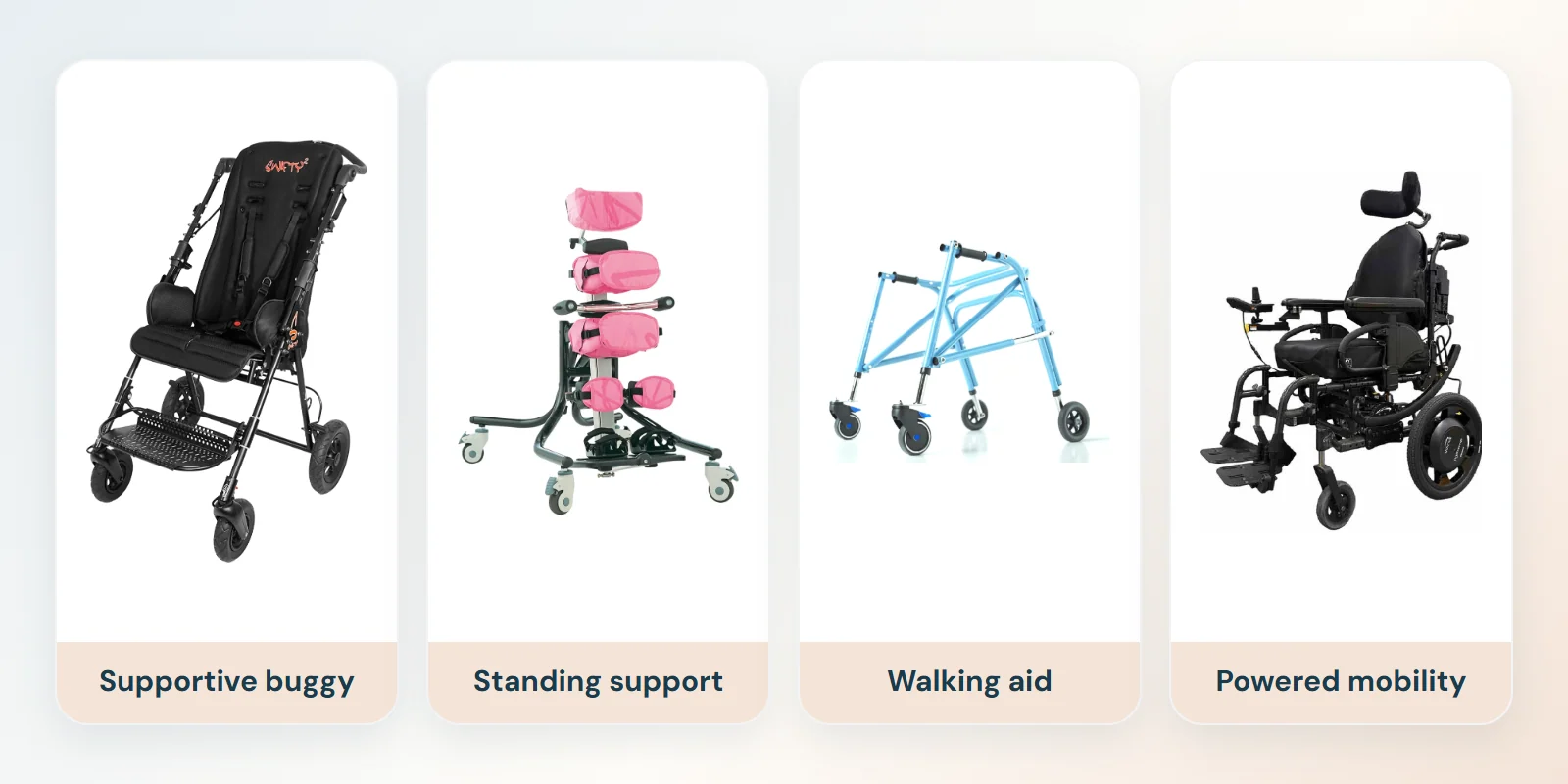
This may include mobility equipment, seating systems, standing support, walking aids or other specialist solutions, depending on what the child has been assessed to need.
Our role is not to replace your therapist or make decisions in isolation.
The best outcomes usually happen when everyone works together: the child, family, therapist, medical team and equipment specialist.
A good equipment journey should include proper assessment, careful product selection, fitting, customisation where needed, caregiver education and aftercare. It should also leave room for review as the child grows.
Most importantly, equipment should never feel like a label placed on your child.
Equipment should be a form of support that helps your child sit, move, rest, learn, play and participate with more comfort and dignity.
Take the next right step
If your child has just been diagnosed, it is okay to feel overwhelmed.
You may not know the right words yet. You may not know which services to call. You may not know what equipment your child will need, or whether your child needs equipment at all.
Start with one step.
Speak with your child’s doctor or paediatrician. Ask about early intervention pathways. Connect with your child’s therapists.
Talk honestly about what daily life looks like at home, in school, during transport and during care routines.
Ask what your child needs support with now. Ask what may need to be reviewed later.
You do not have to solve everything immediately.
The goal is not to buy the most equipment. The goal is to find the right support, at the right time, so your child can be safer, more comfortable and more included in everyday life.
References
Early Childhood Development Agency. (n.d.). How do I enroll my child in the Early Intervention Programme for Infants and Children (EIPIC, EIPIC-P), or Inclusive Support Programme (InSP)? AskGov. Retrieved November 13, 2026, from https://ask.gov.sg/ecda/questions/cm4mgs6st00cuptnryq7jcken
Early Childhood Development Agency. (2026, April 21). Early Intervention Programme for Infants and Children (EIPIC). https://ecda.gov.sg/parents/other-services/early-intervention-services/early-intervention-programme-for-infants-and-children-(eipic)
SG Enable. (n.d.-a). Accessibility & assistive technology. Retrieved November 13, 2026, from https://www.sgenable.sg/your-first-stop/accessibility-assistive-technology
SG Enable. (n.d.-b). Assistive technology. Enabling Guide. Retrieved November 13, 2026, from https://enablingguide.sg/im-looking-for-disability-support/assistive-technology
SG Enable. (n.d.-c). Assistive Technology Fund. Enabling Guide. Retrieved November 13, 2026, from https://www.enablingguide.sg/im-looking-for-disability-support/assistive-technology/assistive-technology-fund
SG Enable. (n.d.-d). Early Intervention Programme for Infants & Children (EIPIC) and Development Support Plus (DS-Plus). Enabling Guide. Retrieved November 13, 2026, from https://enablingguide.sg/im-looking-for-disability-support/therapy-intervention/early-intervention-programme-for-infants-children
SG Enable. (2026, November 6). Early Intervention Programme for Infants and Children – P (EIPIC-P). Enabling Guide. https://www.enablingguide.sg/im-looking-for-disability-support/therapy-intervention/enhanced-pilot-for-private-intervention-providers
Tech Able. (n.d.). Frequently asked questions. Retrieved November 13, 2026, from https://techable.enablingvillage.sg/aboutus/FAQ